
What Promise Would It Kill You to Break?
Soul Friend,
In my last post, inspired by the ancient story of Thecla and the modern story of Alysa Liu, I invited curiosity around a pair of questions:
What might it mean to BAPTIZE YOURSELF?
What might it mean for YOU to claim your life on your own soul's terms?
Maybe you've been consciously living these questions. Or, maybe they've been living in you, beneath your awareness. Maybe you wonder, Why are these even relevant questions? Why would I spend time considering this?
I'll tell you why: because the ONLY WAY we will transcend the vast and deep slavery-systems of Empire —so nakedly exposed these days and so similar to Empire's presence in Jesus' time and place— is through a radical baptism, one we ultimately have to claim for ourselves.
Only a collective that is transcending these systems —that is actively dismantling our own internalized colonization, internalized white supremacist capitalism, our own internalized patriarchy—can imagine and co-create something better.
And aren't we all LONGING for something better?
So, you may wonder, when I speak of baptizing yourself, what do I really mean? Fair question. Let's unpack that.
To baptize oneself is to claim one's inherent goodness and human-divine nature. Baptizing oneself is affirming Jesus' radical claim, announced to his followers, "You are the light of the world!"
He didn't say, "You could become the light of the world, if you work hard enough at it, if you study more, if you perfect yourself." No, he just broadcasted to a motley group of people, people like you and me, "You ARE the light of the world."
As author Paul Smith writes, "[Jesus] affirmed his religion's view that every human being carried the image of God and took it to new levels by reaffirming that every human was the light of the world, even though clouded over by a bushel basket of ego."
Many of us need to baptize ourselves because even the best of religious authorities (like Paul, in Thecla's case), or the best parents, struggle to consistently teach, live and impart such a radical claim.
For example, while this radical claim was the very foundation that drew Thecla to Paul's teachings, when the rubber hit the road, Empire's residual internal roots of meritocracy snagged Paul. He refused to baptize Thecla, claiming she was not ready. I bet you can recall your own Pauls who insisted you were not ready, that you didn't yet know enough to claim your inner light. Or, maybe, you recall people in you life who outright denied the existence of such an inner light.
Compassion on that, for all concerned. And, as we'll see, in Thecla and Paul's case it all works toward the good —thanks, in no small part, to Thecla's determination. Consider how much more powerful it was for Thecla, and for the collective, that Thecla ends up publicly baptizing herself in the presence of a full arena. In doing so, she becomes an inspiration to a whole city, especially the women familiar with the sexual abuse and harassment she has just endured! You may remember how she so utterly refuses the shame projected onto her that when she walks, naked and full of dignity, to the pyre, even the governor is brought to tears. In claiming her own inherent dignity, she is like a modern day Gisele Pelicot, refusing to identify with the shame projected onto her by a patriarchal culture.
Still, it's helpful to acknowledge that Paul, like Gisele and like us, was formed by Empire and its patriarchy, and that even Paul's dramatic conversion, like Gisele's head-on collision with the truth of her life, didn't instantly eradicate all the roots of that formation. For most of us, that is a process.
Empire is of zero support in this process because Empire has zero interest in helping us claim our own goodness; people who know their own goodness and dignity live an embodied sovereignty (we may call that the Christ life), making them difficult to control or manipulate. This frightens the powers that be. In Thecla's story we see how it frightened a mother shaped by patriarchy's expectations, a nefarious power-hungry man like Alexander, but also a well-meaning man like Paul.
Remarkably, such freedom didn't frighten Thecla. It galvanized her. Clinging to Paul's promise of freedom in Christ, Thecla refused to take on her mother's, her abuser's, or Paul's fear. Like Mary, she took God at God's word and responded with a full-bodied YES! Like Mary, Thecla accepted herself as God's favored one; she accepted that God was with her, and all around her, and even within her!
To baptize oneself is also to accept that you are God's beloved daughter or son, made in God's image.
This is made clear in Jesus' own baptism. John the Baptist, who tweaked and expanded existing self-purification rituals by baptizing others emphasized the need for repentance, penance, and forgiveness in response to anticipated judgment. However, in Jesus' own baptism the symbolism expands more radically, focusing not on individual righteousness, but on communal relationship. Instead of hearing John's voice proclaiming Jesus' cleansing, we hear the voice of Godself, descending on Jesus like a dove, and saying, "This is my beloved son, in whom I am well pleased. Listen to him."
I grew up learning that this was a blessing specifically and only for Jesus. It wasn't until my adulthood, I was challenged to consider that this blessing might also be for me, that I might be invited to hear God say to me, "This is my beloved daughter, in whom I am well pleased. Listen to her."
Writing this, I admit that I experience a tinge of worry that fully accepting such a blessing will label me arrogant at best, or a heretic, at worst. Maybe your parents, like mine, avoided positive affirmation, worried it would swell my ego. Truth be told, my own Dad insisted recently to me that his children provide for him the most convincing evidence for the doctrine of original sin. I hadn't considered I might be a poster child for that doctrine, but this might help you and me both understand why, like Thecla, I needed to baptize myself. Literally. More on that in a minute.
First, do you remember my earlier post in which I wrote about the Bannister Effect, the phenomena by which one person breaks a barrier others thought to be impossible and then in a short time afterwards others are able to accomplish the same feat? Using the term "breakthrough model," theologian Paul Smith says Jesus creates his own Bannister effect. In John 8:12 Jesus announces his own light-bearing reality in, "I am the light of the world." But, as we've explored above, he also proclaims back to us, "YOU are the light of the world!" (Matt. 5:14). He is demonstrating the capacity of all human beings to reveal their own inner light-bearing reality. He is embodying a new breakthrough for the world, showing us how to live Love and light up the world, rather than hiding that inherent light under our ego bushel.
This is why, contrary to the obsession of evangelical Christianity, Jesus is NOT interested in being worshiped; he wants to be followed. He is eager for us to claim and embody light as he has modeled. He is eager for us to enact works of service in the world like, and even beyond, what he did. Neil Douglas-Klotz translates John 14:12 from the Aramaic:
By the sacred ground of Unity in which I am always standing, whoever carries the same trust I do, who connects within me with these deep roots of Reality itself, they will do the same works of service that I have done. Indeed, they will serve, love and offer themselves even more abundantly, in ways ever more fitting and beautiful, because my small "I," the temporary part of "me," is departing, leaving only soul returning to its home, the Breathing Life of All.
What we have traditionally heard as "believe in me," Douglas-Klotz translates as, "carry the same trust I do, connect within me with these deep roots of Reality itself." Jesus invites us to trust our birthright light and goodness as children of the living God, to root down into the Source of Reality itself.
This is what I have longed to fully claim, and it is why I baptized myself three years ago when Vernon and I made a pilgrimage to the ancient isle of Iona.
I hadn't planned to baptize myself, but even before leaving for the pilgrimage I began shedding a skin of the small "I". Because this wasn't the first sort of "quest" I'd gone on, I knew that helpful preparation included cleaning out physical, emotional, relational and spiritual clutter in order to make room for new life. In that spirit I set about cleaning out a closet that held binders and binders of content for past groups, retreats and offerings I'd led. Going into it, I thought I'd mostly be organizing those things and culling just a bit. But as I opened binder after binder and notebook after notebook, I realized that the content no longer reflected who I was and how I understood the Divine. To my great surprise I dumped nearly the entire closet into our recycling bin! This felt a both terrifying and freeing.
I didn't know it then, but I was getting ready for my baptism. I was exiting the womb of an old theology that felt cramped and was no longer was nourishing me. Like Thecla, I was leaving home.
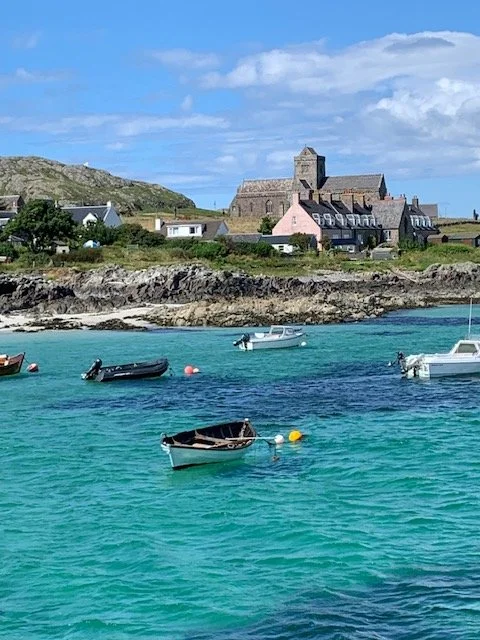
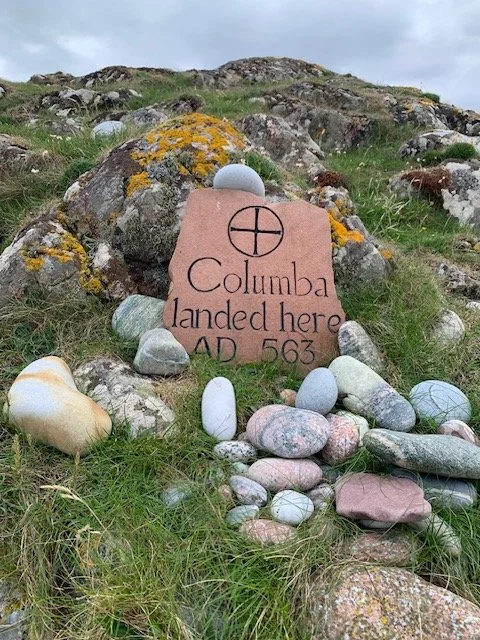
We arrived on the island of Iona, aware we were crossing a threshold into a new stage of life, one no longer focused on raising a family. Known as the cradle of western Christianity from St. Columba's landing there in 563, and as a pre-Christian spiritual nexus long before that, Iona is often described as a "thin space," the Celtic term for a location or moment where the veil between earth and heaven is porous, or thin. We were there to listen for what those glorious waters might say to us. We were there to make a promise it would kill us to break.
After almost a week of immersing ourselves in ancient story in an ancient holy place amidst a ecumenical prophetic community known for its ecological consciousness, evolving spirituality, and radical hospitality, we were invited to wander the island in solitude for an entire day. I knew where I wanted to begin, at Dun-I, both the highest point on the island and home to St. Brigid's Well.
Dun I's high point is marked by a rather phallic monument, around which visitors gather, many touching it's hard presence, as if for luck.
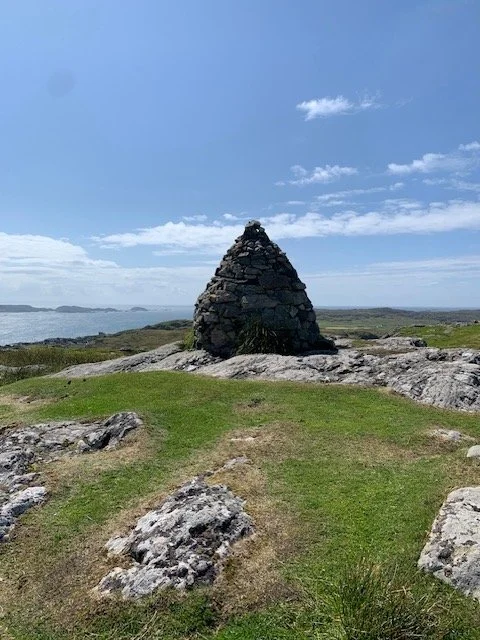
St. Brigid's well, just a stone's throw away, is hidden in a cleft, a bit north of the monument. Most visitors, unaware of its presence, never visit. Thankfully, I'd been told by a wise old woman where to find this sacred, somewhat hidden pool.
Until the mid 1970's this well provided all the water for the nearly 200 inhabitants of the island, and for their livestock, mostly sheep. It is named for St. Brigid of Kildare, a 5th century Irish abbess famous for founding a "double monastery." Going against the patriarchal norms of the day, she led both men and women. She held high spiritual authority and her monastery in Kildare became known as a major center for learning and religion. Some traditions even claim she was consecrated as a bishop! She is remembered for her fierce compassion, her connection to the land and waters, and for her care of the poor and weary.
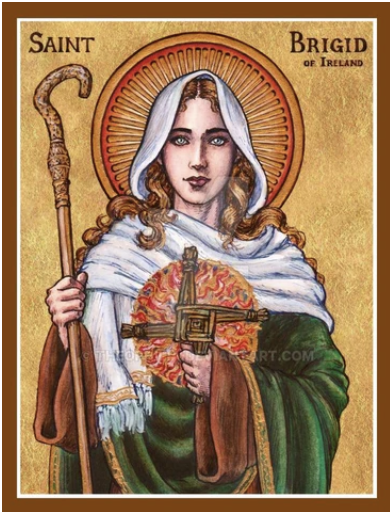
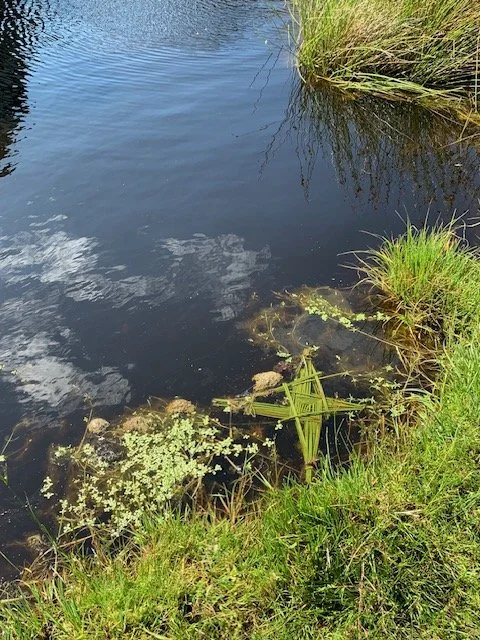
As I sat next to the pool, on an outcropping, my feet resting in spongy ground, I saw her cross floating in the pool, and it's as though her energy seeped into me, nourishing my own courage. Suddenly I knew: now is the time and place to baptize myself. And I did. Though I'd never heard of Thecla. Though I had no idea any woman had ever done such a thing. Brazen, I baptized myself in the name of the Birther/Father-Mother of the Cosmos, in the name of the Innocent Child, in the name of the Breathing Life of All.
Resting there, my hair dripping, looking at my reflection, part of me feared a sort of damning lightning strike for an act that felt audacious and bordering on heretical. I'm laughing about that as I write this, realizing that lightning did strike in the moments after Thecla baptized herself. But do you remember? The lightning struck and killed those vicious seals, not the holy and audacious Thecla. That lightning encircled her in a protective ring of fire.
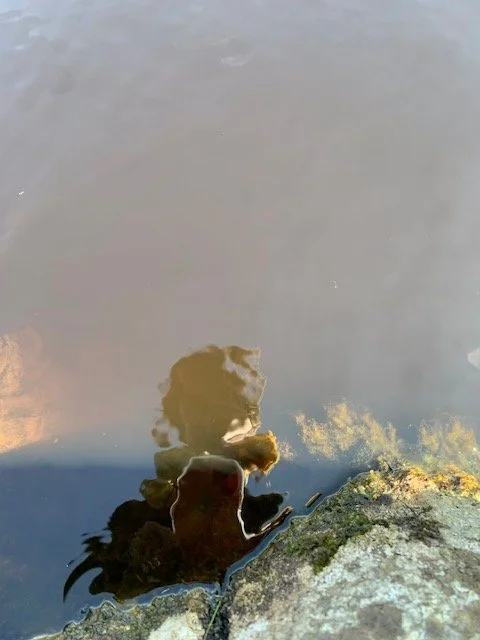
I moved on from the fears that weren't really my own to something more lifegiving. I asked myself, "What is the promise it would kill me to break?"
Not knowing what I'd been doing, I realize I'd gathered up that promise from my garden before we left. I'd created a sacred bundle of beautiful flowers and aromatic healing plants and herbs and I'd been carrying it the whole journey, in my daypack.
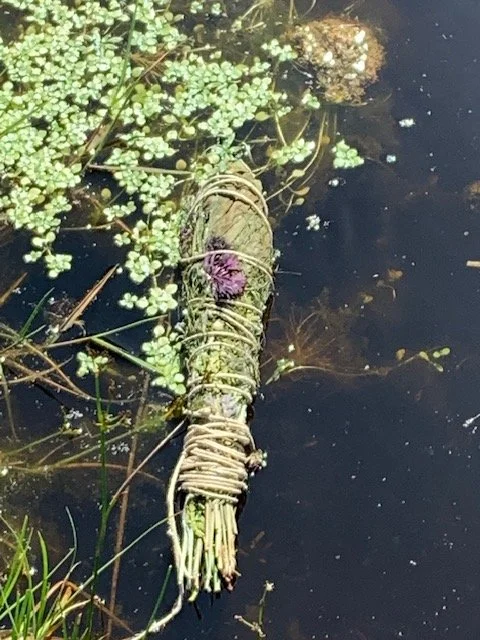
I placed it now in St. Brigid's Well, my promise to keep giving birth. My promise to let myself be penetrated by what frightens and allures me, and then to let life grow and let life go. I promised to welcome life and to let it die. I promised to let myself be remade, again and again. I promised to trust this process in others, even when it scared me.
I want to find out what is Real and what is not. I want to claim the only life that is mine to claim.
Soul Friend, where are you on this pilgrimage of reclaiming your inherent goodness? Of claiming your own sacred life?
David Whyte, in his poem "All the True Vows" challenges us and hints at how we might do this, writing,
Hold the truth you make
every day with your own body,
don't turn your face away.
Hold your own truth
at the center of the image
you were born with.
Those who do not understand
their destiny will never understand
the friends they have made
nor the work they have chosen
nor the one life that waits
beyond all the others.
Soul Friend, may courage abound! Don't look away. Your body insists on certain things. Pay attention to that. You are drawn to certain people. Trust this. A sort of work (whether its your job or not doesn't matter) keeps calling to evoke where your deepest joy meets the world's deep need.
Let yourself know what you know. Trust like Jesus did. Connect, in him, in you, to the deep roots of Reality. When you stand in this Unity, when we stand together in this Unity, we will do great things!
The realm of God is very near. It's the one life that waits beyond all the others.